
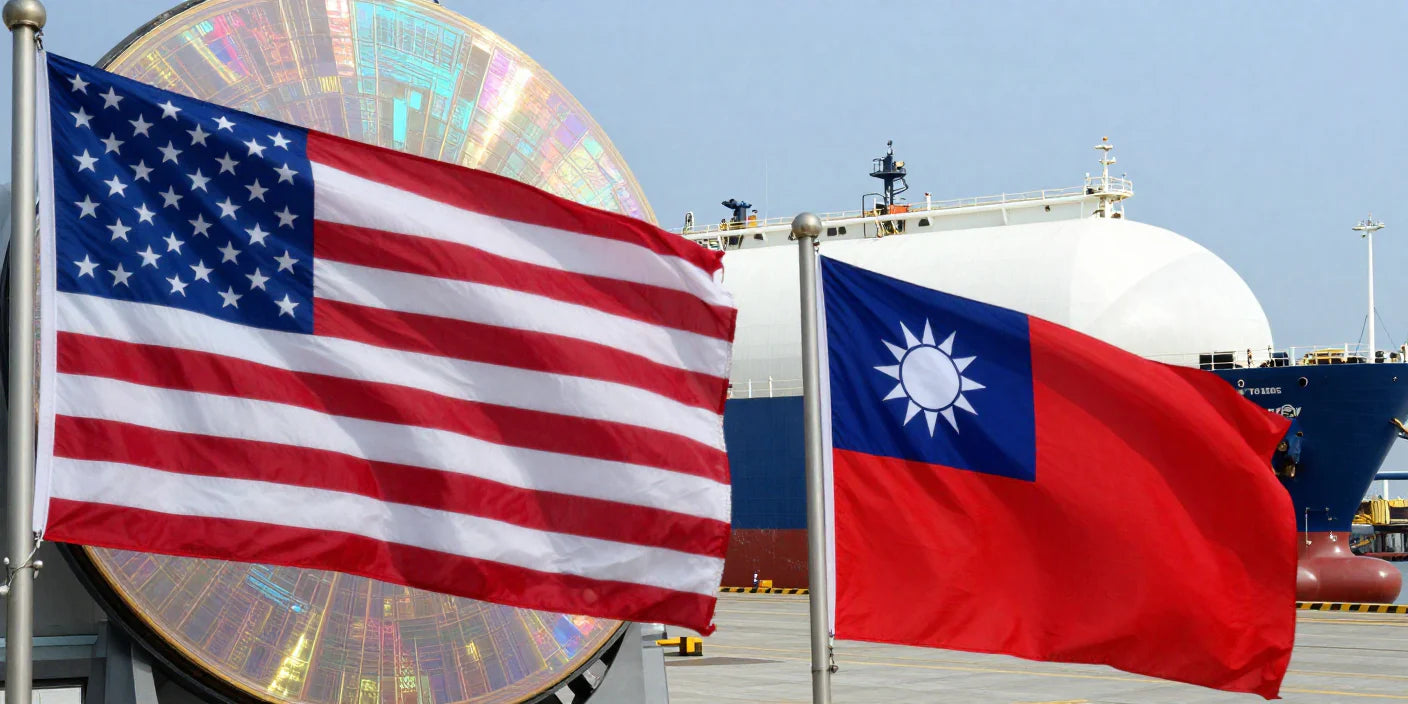
The United States and Taiwan have formally signed a trade agreement confirming tariff reductions and major Taiwanese purchasing commitments — a move aimed at strengthening high-technology supply chains and rebalancing trade relations.
The pact follows a January framework announcement and now cements a structural shift in US–Taiwan economic ties.
Key Deal Highlights
• US tariffs on many Taiwanese exports reduced from 20% → 15%
• Average effective tariff lowered further to 12.33%
• “Most Favored Nation” (MFN) treatment secured
• Over $84+ billion in US goods purchases (2025–2029)
• 99% tariff barriers reduced or eliminated on US goods entering Taiwan
Tech Supply Chain Resilience at the Core
Semiconductors remain the central pillar of the agreement.
Taiwan - home to industry giants like Taiwan Semiconductor Manufacturing Company (TSMC) - plays a dominant role in global chip production:
• ~60% of global semiconductor foundry market share
• Over 90% of advanced chip manufacturing capacity
The agreement aims to:
✔ Reduce trade friction
✔ Secure high-tech supply chains
✔ Encourage US-based chip manufacturing investment
This aligns with Washington’s broader industrial policy push toward domestic semiconductor capacity.
Taiwan’s Spending Commitments (2025–2029)
Taiwan committed major long-term purchases of US goods:
• $44.4 billion – LNG & crude oil
• $15.2 billion – Civil aircraft & engines
• $25.2 billion – Power equipment & grids
These purchases:
• Strengthen US energy exports
• Deepen aerospace cooperation
• Support US industrial sectors
Tariff Structure Explained
Vice Premier Cheng Li-chiun clarified:
• Initial tariff: 15%
• Final effective average levy: 12.33%
• No stacking of reciprocal tariffs
This closes competitive gaps created by earlier FTAs that excluded Taiwan.
Strategic Implications
1. US–China Tech Rivalry
The agreement strengthens US access to Taiwan’s semiconductor ecosystem amid ongoing tensions with Beijing.
2. Energy Diversification
Taiwan reduces reliance on Middle Eastern and regional supply chains by locking in US LNG contracts.
3. Industrial Rebalancing
US benefits from inbound Taiwanese tech investments and outbound export demand.
Political Layer
The agreement:
• Requires review by Taiwan’s opposition-controlled parliament
• Comes amid continued US–China strategic tensions
• Reinforces Washington’s Indo-Pacific economic alignment
China has previously criticized deepening US–Taiwan economic ties.
Economic Impact Snapshot
| Metric | Impact |
|---|---|
| Tariff Reduction | +Trade Competitiveness |
| Energy Purchases | +US Export Revenue |
| Semiconductor Investment | +Supply Chain Stability |
| Aircraft Orders | +US Aerospace Growth |
What Comes Next?
• Increased US semiconductor capacity
• Greater Taiwanese capital deployment in US tech
• Possible Chinese economic response
• Deeper Indo-Pacific trade realignment
The deal marks more than tariff cuts - it signals structural geopolitical repositioning.
📰 News Summary
The United States and Taiwan have formally signed a trade agreement confirming tariff reductions and major Taiwanese purchasing commitments — a move aimed at strengthening high-technology supply chains and rebalancing trade relations.The pact follows a January framework announcement...

Share:
Business Aviation Growth in Dubai Fuels Tourism and Luxury Travel Demand
SFTC 2026: Decarbonisation & Financial Innovation Redefine Global Ship Finance