
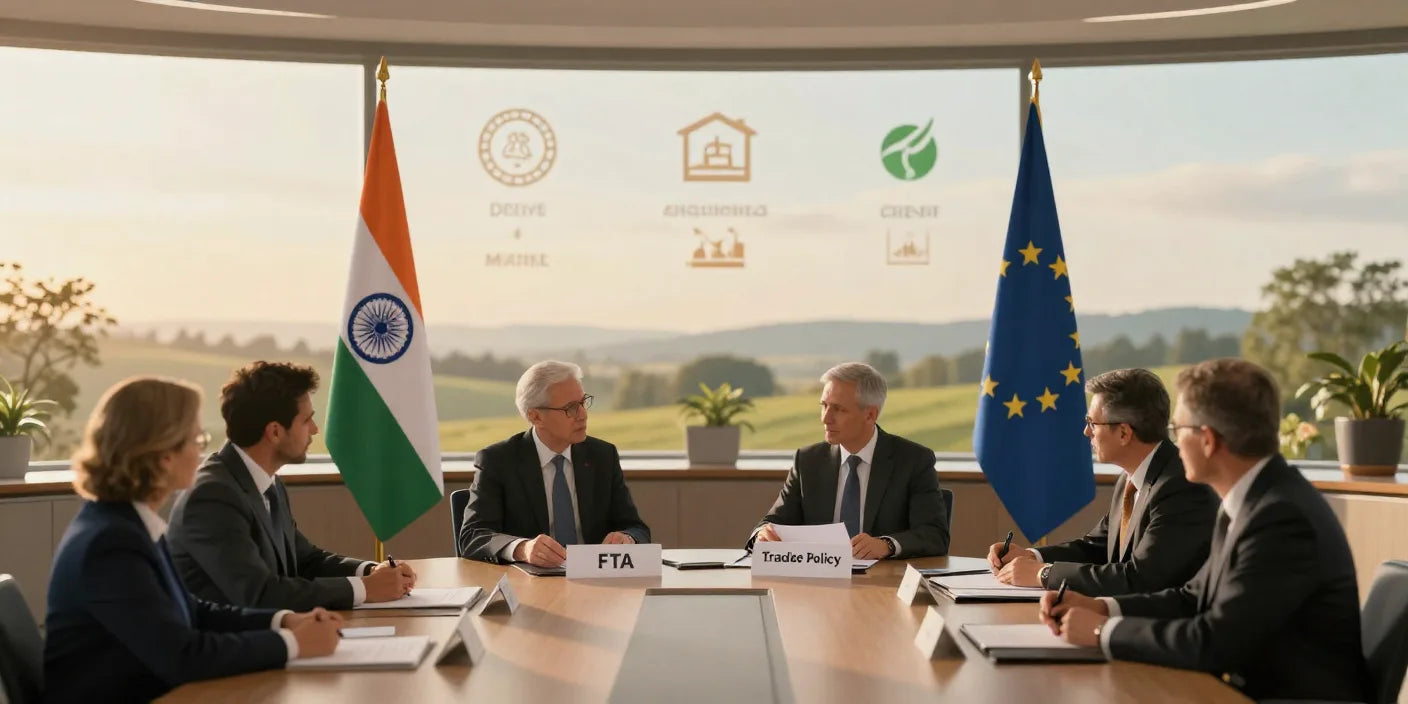
India’s renewed push to deepen economic ties with Europe is no longer symbolic-it is strategic, urgent, and time-bound. The back-to-back visits of External Affairs Minister S. Jaishankar and Commerce Minister Piyush Goyal to Europe at the start of the year sent a clear signal: the India-EU Free Trade Agreement (FTA) is now a top political and economic priority.
After successfully operationalising trade agreements with EFTA, the UK, Oman and New Zealand, India sees the EU pact as the most consequential of them all. Not just because of the EU’s market size, but because this agreement is expected to go far beyond tariff reductions, covering investment protection, sustainability, digital trade, public procurement, and geographical indications.
Why the India-EU FTA Matters More Than Ever
Negotiations that began as early as 2007 gained fresh momentum only in June 2022, after a nine-year hiatus. While progress remained slow until the end of 2024, 2025 marked a turning point, driven by direct political intervention at the highest levels.
The visit of European Commission President Ursula von der Leyen to India, along with the EU College of Commissioners, resulted in a clear mandate: finalise the FTA. Since then, negotiators have worked at unprecedented speed-closing 10 out of 24 chapters and holding multiple ministerial-level meetings across global forums.
The Sticking Points: Where Gaps Still Remain
Despite this momentum, some chapters remain politically sensitive and technically complex.
Bilateral Investment Treaty (BIT)
India prefers disputes to first go through domestic courts, while the EU is pushing for a multilateral investment court system. This reflects deeper differences over regulatory sovereignty versus investor protection, making convergence difficult but unavoidable.
Government Procurement
The EU wants access to India’s vast public procurement market. India remains cautious, fearing exposure of domestic industry-especially MSMEs-to global competition. Though India has opened procurement selectively in recent FTAs, this remains a core red line.
Sustainability and Non-Tariff Barriers (NTBs)
Perhaps the most sensitive chapter is sustainability. While EU tariffs are relatively low, non-tariff barriers such as CBAM, deforestation regulations, carbon disclosure norms and corporate due diligence rules effectively act as trade filters.
For Indian exporters-especially MSMEs-these compliance-heavy measures increase operational complexity. As firms align with global ESG norms, the need for accurate financial reporting and compliance tracking has also increased, indirectly driving demand for bookkeeping services in India, particularly among export-oriented businesses navigating EU sustainability frameworks.
Geographical Indications (GIs)
The EU is seeking broad GI protection, largely for agricultural products, as seen in its deals with Vietnam, Mexico and MERCOSUR. India insists on reciprocity and adherence to domestic GI verification laws-an issue rooted in legal parity rather than trade resistance.
Why Timing Is Critical
Global trade disruptions triggered by US tariff escalations have altered priorities. While the EU has already sealed a deal with the US-despite internal criticism-it now sees India as a strategic counterbalance and growth partner.
With EU leadership expected in Delhi around Republic Day, both sides are under pressure to announce tangible progress. The groundwork is largely done. What remains is political flexibility on sustainability norms, NTBs, and investment rules.
Conclusion
The India-EU FTA is no longer about market access alone. It is about aligning regulatory philosophies, managing sustainability transitions, and building trust in a volatile global trade environment.
Negotiators on both sides must now move slightly beyond rigid negotiating positions-especially on sustainability and NTBs-to close what could be India’s most comprehensive and transformative trade agreement to date.
📰 News Summary
India’s renewed push to deepen economic ties with Europe is no longer symbolic-it is strategic, urgent, and time-bound. The back-to-back visits of External Affairs Minister S. Jaishankar and Commerce Minister Piyush Goyal to Europe at the start of...

Share:
India’s Exports to China Surge 33% to $12.22 Billion, Signalling Structural Trade Shift
Oil Bombshell in Vietnam: Murphy’s Giant Discovery Reshapes ASEAN Energy Outlook