
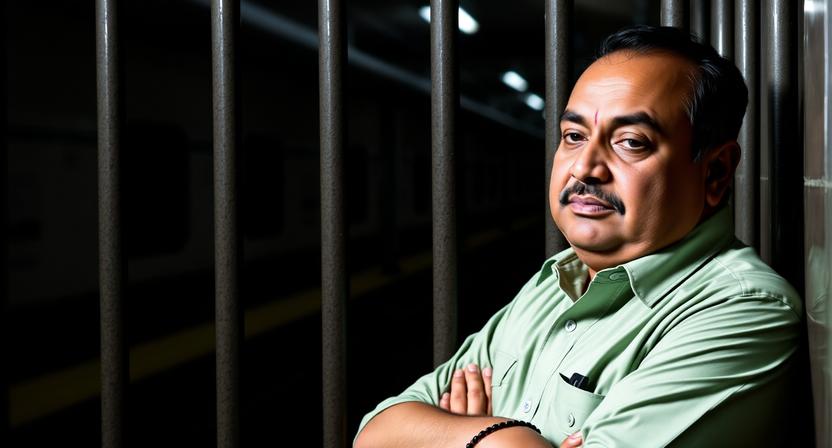
A special CBI court in Vijayawada has convicted and sentenced a former South Central Railway (SCR) engineer to one year of simple imprisonment in a nearly two-decade-old bribery case. The court found Matta Dharma Rao, then Assistant Divisional Engineer (ADE) with SCR at Bhimavaram in West Godavari district, guilty of demanding and accepting a bribe from a railway contractor.
The 2006 Bribery Allegation
According to the Central Bureau of Investigation (CBI), the case dates back to November 29, 2006, when a complaint was lodged by a railway contractor about illegal gratification allegedly demanded by Rao. The CBI registered an FIR the same day, launching a probe into the charge that the ADE had abused his official position to extract a bribe.
Investigators later alleged that Rao demanded a digital camera with charger and batteries worth around ₹11,200 as a bribe. In return, he allegedly promised to:
- clear a contractor’s already-submitted bill of about ₹1.87 lakh, and
- facilitate payment of another pending bill of ₹77,000,
while also implying that he could cancel the pending bill if the demand was not met.
Trial and Conviction Under Prevention of Corruption Act
Following investigation, the CBI filed a charge sheet against Rao in June 2007, booking him under relevant provisions of the Prevention of Corruption Act, 1988. After a prolonged trial, the special judge for CBI cases in Vijayawada, K. Sita Ramakrishna Rao, pronounced the verdict on November 28, 2025.
The court held that the prosecution had successfully proved that:
- Rao demanded an illegal gratification not due to him under any lawful remuneration.
- He accepted the digital camera and accessories as a bribe.
- The bribe was directly linked to his official functions in passing and processing contractors’ bills.
On this basis, the court convicted him and sentenced him to one year of simple imprisonment and imposed a fine of ₹1,500. In default of payment of the fine, a further term of simple imprisonment was also stipulated.
Why a Digital Camera Counts as a Bribe
While many corruption cases involve cash, the law is clear that any valuable thing demanded or accepted as a quid pro quo can qualify as a bribe. In this case, the bribe took the form of a consumer electronic item rather than currency — but that did not diminish its seriousness under the Prevention of Corruption Act.
The court’s reasoning reinforces a key principle: what matters is not the mode of payment, but the corrupt intent and link to official acts — here, the clearing of bills and threat of cancellation. For public servants, even “gifts” like gadgets, travel or luxury items can amount to prosecutable illegal gratification when tied to official favours.
Signals for Public Procurement and Rail Contracts
The conviction sends an important message across government departments and particularly within large infrastructure-heavy entities like Indian Railways:
- Contract diligence: Contractors often rely heavily on field-level officials to certify, clear and process payments. Abuse of that discretion for private gain erodes trust in public procurement.
- Time lag is not immunity: Even though the case originated in 2006, the final judgment in 2025 shows that long timelines do not automatically shield accused officials from eventual conviction.
- Non-cash bribes count: Accepting consumer goods in lieu of cash is neither subtle nor safe — such benefits can be tracked, valued and treated as illegal gratification in court.
CBI’s Anti-Corruption Footprint
The case also illustrates how CBI’s anti-corruption work often plays out over years: a complaint, a trap or investigation, charge sheet, and eventually a trial culminating in conviction or acquittal. While critics frequently highlight delays, investigators argue that complex corruption cases demand meticulous documentation, witness testimony and forensic linking of benefits to official acts.
In recent years, the CBI has repeatedly emphasised that even seemingly “small” bribe cases — such as demands involving modest sums or consumer goods — are pursued to establish a culture of accountability and deterrence among public servants.
What Happens Next
Rao retains the right to challenge the CBI court’s verdict before a higher court. Appeals in such cases often question:
- the reliability of complainant and panch (witness) testimony,
- the chain of custody and valuation of seized items, and
- whether demand and acceptance of bribe were proved beyond reasonable doubt.
However, unless the sentence is stayed or overturned by an appellate court, the conviction stands as a formal finding of guilt under the Prevention of Corruption Act, with all consequential impacts on service-record and pensionary benefits (if not already retired).
For more coverage on corruption cases, accountability in public procurement and enforcement trends across India, follow Accounting firms in India — where complex legal and financial stories are broken down with clarity and context.

Share:
Jharkhand FIR Alleges Business-Takeover, Coercion Against Former IAS Officer Vinay Kumar Choubey
ED Restores ₹520.80 Crore to Claimant in Cox & Kings Money-Laundering Case