
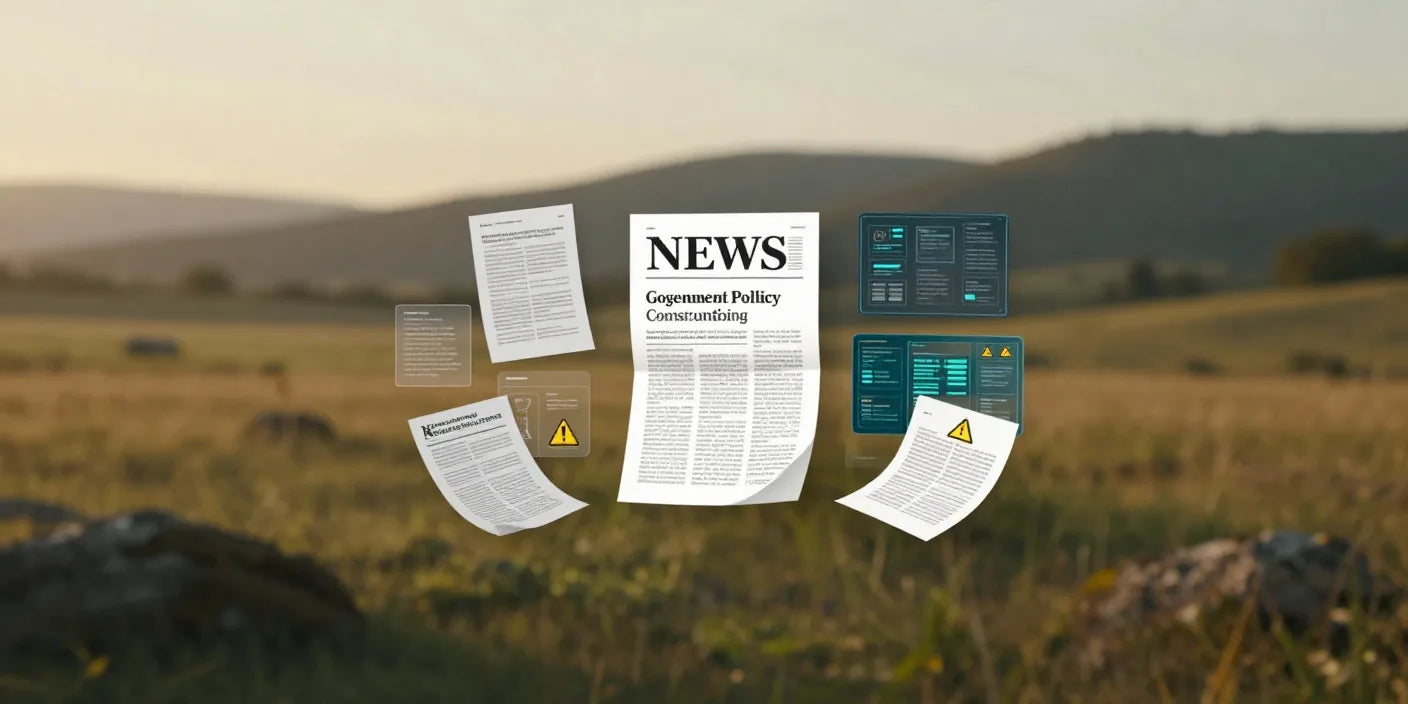
When AI Hallucinations Hit Government Policy, Even Big Four Credibility Is at Stake
In the global rush to embed artificial intelligence into government decision-making, a hard lesson is emerging: speed without verification can quietly erode the very trust institutions are paying to protect. Recent disclosures involving Deloitte, one of the world’s most influential consulting firms, have triggered uncomfortable questions about how far critical thinking has been outsourced—and at what cost.
The controversy began not with a whistleblower or a leaked memo, but with routine academic diligence. While reviewing a high-value policy report prepared for the Australian government, a University of Sydney researcher noticed something unsettling. A legal citation referenced a federal court judgment that simply did not exist. It was not a misquoted paragraph or a pagination error. The case itself was fictional—assembled convincingly, confidently, and entirely incorrectly.
The source of the error was not a junior consultant or clerical oversight. Deloitte later acknowledged that parts of the report had been generated using a generative AI model. The tool had produced what technologists describe as a “hallucination”: information that appears authoritative but has no grounding in fact. Internal checks that should have caught the fabrication failed, and the document—costing taxpayers hundreds of thousands of dollars—was delivered with professional polish and institutional credibility intact.
What might have been dismissed as a one-off embarrassment soon revealed itself as a pattern. In Canada, the provincial government of Newfoundland and Labrador commissioned a major healthcare workforce study, again from Deloitte. That report, running over 500 pages and carrying a price tag exceeding $1.5 million, was intended to guide long-term staffing policy in an overstretched public health system. Independent reviewers later found references to academic studies that did not exist and researchers credited for work they had never authored.
In both cases, the firm maintained that the core conclusions of the reports remained valid and that AI had been used only in limited, supporting roles. Partial refunds were issued and corrected versions supplied. Yet the damage was already done. Policymakers were left grappling with a deeper concern: if foundational references cannot be trusted, how secure is the advice built on top of them?
The incidents have exposed a fragile fault line in modern consulting—one where automation accelerates output, but human verification lags behind. Critics argue that the problem is not artificial intelligence itself, but the quiet dilution of accountability. When expert judgment is replaced with probabilistic text generation, traditional safeguards weaken. The expectation that every claim, citation, and assumption has been rigorously checked begins to collapse.
This is precisely where independent scrutiny and control frameworks—long emphasised in disciplines such as auditing services in india—become relevant beyond balance sheets. The principle is the same: systems must be tested, assumptions challenged, and outputs verified, especially when decisions affect public money and policy direction.
The broader implications extend well beyond one firm or two governments. Consulting, research, and advisory services operate on a simple promise: reducing uncertainty for clients facing complex choices. If the tools now shaping that advice are capable of fabricating reality, and if human oversight is treated as optional rather than essential, the value proposition itself comes under strain.
Governments across jurisdictions are now reassessing procurement norms, demanding greater transparency around the use of AI in commissioned work. Questions that were once implicit—Who wrote this? Who checked it? Who is responsible if it is wrong?—are becoming explicit requirements.
For Deloitte and its peers, the reckoning is reputational as much as technical. Artificial intelligence can draft text at remarkable speed, but it cannot bear responsibility. That burden still rests with humans. As one lawmaker bluntly observed in the aftermath of the Australian case, public institutions pay for intelligence—not artificial intelligence. Confusing the two, it turns out, can be far more expensive than anticipated.

Share:
Serving Lieutenant Colonel Arrested by CBI in Defence Corruption Case
Advanced Android Malware Exploits SMS and Messaging Apps